
I knew I used AI heavily in 2025. I did not have a useful sense of the scale until the year-end summaries arrived. One counted the conversations. The other counted the machinery running behind my software work.
What OpenAI counted
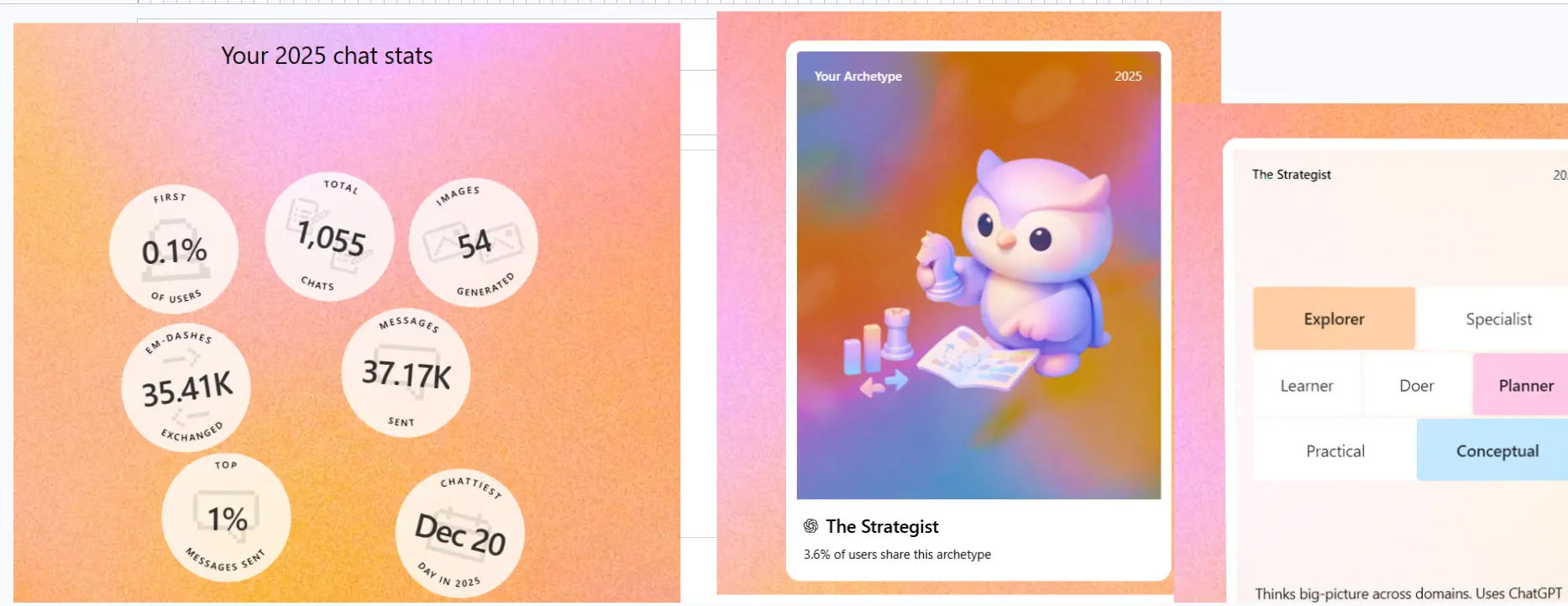
OpenAI counted 1,055 chats, 37,170 messages sent, and 54 generated images. It placed me among the first 0.1 percent of users and in the top one percent by messages sent. It also counted 35,410 em dashes exchanged, which is a funny little signature of how much long-form writing and editing was happening in those conversations.
The recap labeled me “The Strategist.” That fits the way I was using ChatGPT: not mainly for isolated answers, but for working through business ideas, technical architecture, writing, planning, debugging, and whatever question had taken over my attention that day.
What Cursor counted
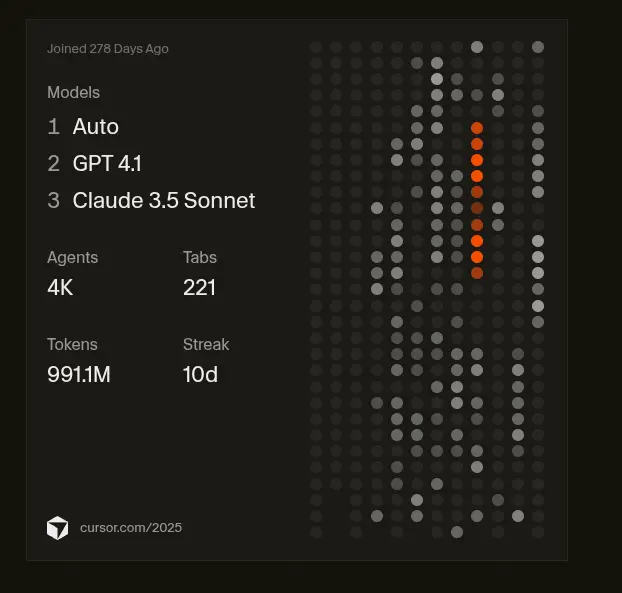
Cursor showed a different side of the same habit. Over 278 days it recorded 4,000 agent runs, 221 tabs, and 991.1 million tokens. Its top models were Auto, GPT-4.1, and Claude 3.5 Sonnet.
That token number should not be read as 991.1 million Claude-only API tokens. Cursor was routing work across several models, and the recap does not expose the split between input, output, cached context, or internal agent activity. Coding agents also repeatedly read files and carry large working contexts, so their token counts grow in a way that ordinary chat counts do not.
What would that many Claude tokens cost now?
Anthropic currently prices Claude Sonnet 5 at $2 per million input tokens and $10 per million output tokens. Using the Cursor total as a simple token-for-token comparison gives three useful reference points:
- If all 991.1 million were input tokens: 991.1 × $2 = $1,982.20.
- If all 991.1 million were output tokens: 991.1 × $10 = $9,911.00.
- At an illustrative 80 percent input and 20 percent output split: $1,585.76 + $1,982.20 = $3,567.96.
That is not an estimate of Cursor’s actual cost, and it is definitely not an invoice I avoided. Prompt caching, model routing, provider agreements, and the mix of models all change the economics. Anthropic also notes that Sonnet 5’s newer tokenizer can produce about 30 percent more tokens for the same text than earlier Sonnet models, so even a token-for-token comparison is not the same as recreating the exact 2025 workload.
Why I think of 2025 as a subsidized era
I was buying access to products, not watching a raw API meter. OpenAI, Anthropic, Cursor, and other companies were competing to make increasingly capable models feel like ordinary software subscriptions. Routing, usage limits, caching, and provider deals kept most of the underlying economics out of sight.
That made 2025 a strange and unusually productive window. An individual developer could throw enormous amounts of model work at experiments, client systems, writing, and prototypes for a predictable monthly price. The retail price of access and the theoretical API value of the activity were clearly not the same thing.
What the numbers mean to me
The interesting part is not that I found a way to produce a large number. It is that AI had stopped being a special tool I occasionally opened. It had become part of how I thought through problems and how I produced software.
The ChatGPT total reflects thousands of conversations used to clarify ideas. The Cursor total reflects thousands of agent runs used to turn ideas into working systems. Together, they document the year when AI moved from an experiment beside my work to infrastructure inside it.
Sources and calculation notes
- The two graphics are my personal 2025 usage summaries from OpenAI and Cursor.
- Anthropic’s current Claude API pricing lists Sonnet 5 at $2 per million input tokens and $10 per million output tokens.
- The 80/20 split is an illustration, not a claim about the undisclosed composition of the Cursor total.