
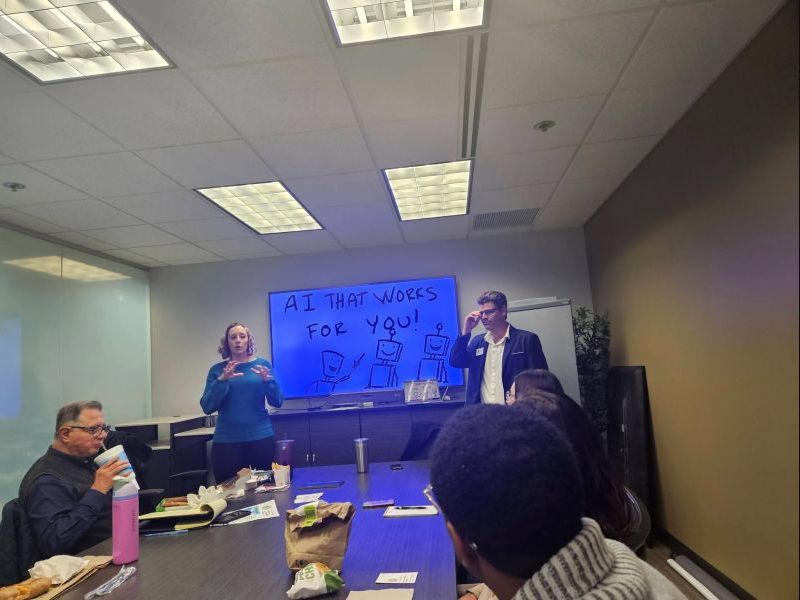
Most people in the room did not need a tour of the AI industry. They needed a useful starting point: what these tools can do today, what is worth trying, and how to tell the difference between a novelty and something that can help their business.
Start with the tools people can actually try
I covered familiar models including ChatGPT and Grok, along with conversational voice tools. That gave everyone common ground. People could connect the discussion to products they had already heard about instead of starting with infrastructure, model architecture, or a wall of new terminology.
The goal was not to make the technology sound mysterious. It was to help local business owners form a practical mental model and leave with better questions than they arrived with.
Do not stop at prompting
The public chat interfaces are the easiest place to begin, but they are only the visible edge of the work. After the session, the conversation moved toward custom configuration, retrieval, and automation—ways AI can become part of an operating workflow rather than another tab someone occasionally opens.
That distinction matters to me. A good introduction should make the first experiment approachable without pretending the first experiment is the whole subject.
The room told me what landed
An attendee described the presentation as the kind of primer many local business owners needed. He specifically called out the overview of current models and voice tools, then wrote about our conversation afterward on deeper automation and implementation.
That is a useful outcome for an introductory talk. The audience leaves with enough understanding to participate, and the people ready for the next layer know where the conversation goes from there.
What I took from it
- Match the technical depth to the room instead of delivering the same talk everywhere.
- Use recognizable tools to establish common ground before introducing deeper implementation ideas.
- Give people a realistic first step without shrinking the subject to basic prompting.
- Leave room after the presentation for the questions that reveal what the audience actually wants to solve.
Primary sources
- November 2025 talk announcement on LinkedIn
- Practical AI speaking announcement
- My event recap and photographs
- An attendee's description of the session and follow-up conversation