In 2015, most people had heard very little about consumer virtual reality—and even fewer had experienced it themselves. A year later, I was back at TEDxGatewayArch organizing an entire mixed-reality section of the event.
One headset, an empty table, and a line for hours
I had developed a reputation for VR around the T-REX technology community in downtown St. Louis. I kept equipment at my office and regularly let people try it, so the director of TEDxGatewayArch asked me to bring a VR demonstration to the organization’s Catalyst event.
My friend Jeremy helped me run it. We brought a Samsung Gear VR headset, a compatible phone, and everything we needed to give attendees their first experience inside VR.
Our table was beside a much larger exhibitor with an impressive collection of gadgets. Trying to compete by adding more equipment would only make our small display look busier.
Instead, I removed everything from our table. The Gear VR headset sat by itself in the middle.
That simple presentation made the experience immediately understandable. There was no wall of marketing copy and no collection of devices that needed to be explained. There was one unfamiliar object and an obvious question: What happens when I put that on?
Because so many attendees wanted to try it, we had to keep each demonstration to roughly 30 seconds. That meant helping someone into the headset, getting the fit right, starting the experience, watching for problems, and moving smoothly to the next person—all while keeping the interaction welcoming.
One reaction has stayed with me. A serious-looking businessman approached the table visibly skeptical. He put on the headset with a frown and spent about 30 seconds inside the experience.
When he removed it, he was grinning. He looked at me and nodded.
Nothing I could have said about virtual reality would have created that reaction. The demonstration did the work.
That was the larger lesson from the event: some technologies are difficult to communicate through descriptions, feature lists, or even video. People need a safe and approachable way to experience them directly.
From one table to a complete program
A year after running that Gear VR demonstration, I returned as Director of Mixed Reality Exhibitors. This time, I wasn’t responsible for one headset. I was organizing an entire section of the event.
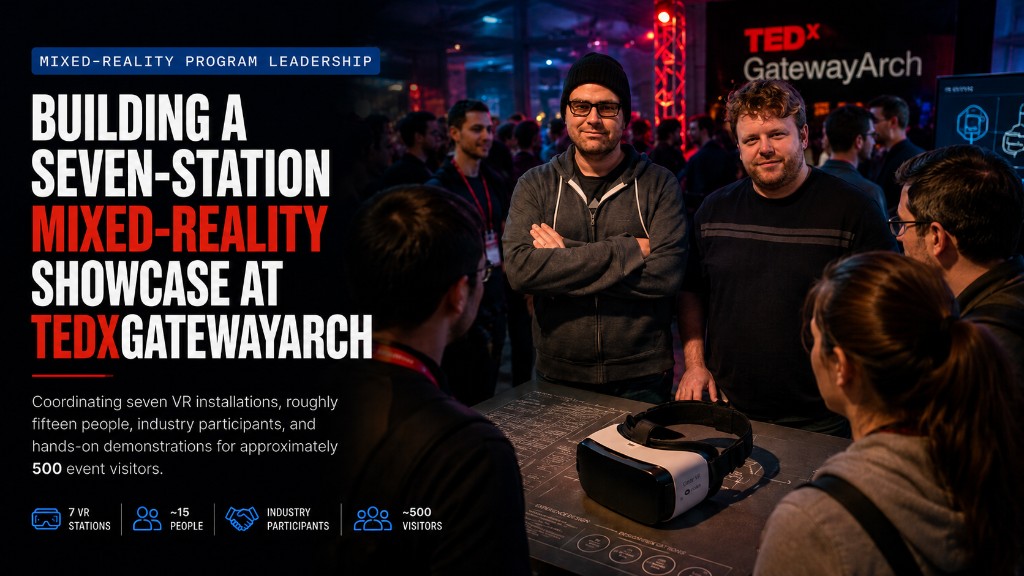
The mixed-reality area included approximately seven VR installations, fifteen exhibitors and volunteers, a DJ, and technology representatives from companies including NVIDIA and Oculus. Roughly 500 people moved through the event that day.
My responsibility was to bring those pieces together into a showcase that attendees could actually explore.
Supporting the people behind the technology
NVIDIA created a large VR installation. Oculus was also represented, and Oculus Story Studio’s Max Planck attended as a speaker. Max brought demonstration hardware with him; our team helped set it up and handled the public demonstrations.
I only spoke with him briefly. The meaningful part of that interaction was the work around it: receiving hardware from a visiting speaker, getting it operational in the event environment, and turning it into something attendees could experience.
Max’s talk, “How Virtual Reality Changes the Story…and the Audience” , reinforced the theme of the exhibit area. The talk explained what immersive media could become; the demonstrations let people experience the technology for themselves.
The work behind the showcase
Each installation had its own hardware, people, and requirements. Someone had to recruit participants, coordinate equipment and staffing, help exhibitors get established, keep demonstrations running, and make an unfamiliar technology feel approachable.
That was the work I took on.
The result was a mixed-reality area where hundreds of visitors could move between several interpretations of VR rather than seeing a single controlled demonstration. They could compare experiences, ask questions, talk directly with people working in the field, and begin forming their own understanding of the medium.
Looking back
- I noticed that a first-time VR experience needed a clearer invitation, not a larger display.
- I reduced the table to one focal point and let curiosity start the conversation.
- I helped a sustained line of first-time users through unfamiliar hardware without losing the personal interaction.
- I adapted the demonstration to roughly 30-second sessions so more attendees could participate.
- I observed user reactions directly and learned where a hands-on experience communicated more effectively than explanation.
- I expanded that successful single-table demonstration into a multi-installation program.
- I coordinated developers, volunteers, industry representatives, hardware, entertainment, and attendee flow.
- I helped visiting participants turn the hardware they brought into reliable public demonstrations.
- I connected stage programming with hands-on learning so attendees could experience the subject being discussed.
- I created space for several perspectives on an emerging platform rather than presenting one tightly controlled product pitch.
Archive note
Samsung Gear VR and its supporting software are now discontinued, so the 2015 section is not current setup guidance. It documents early hands-on work introducing an emerging platform to the public.
The 2016 event took place during an early period of consumer VR adoption. The hardware, platforms, and company names have changed substantially since then. This page documents the organization and developer-community work behind both showcases rather than offering current implementation guidance.
TEDxGatewayArch Catalyst took place on November 7, 2015, at Harris-Stowe State University. TEDxGatewayArch Bounce was held on December 10, 2016, at the Skip Viragh Center for the Arts at Chaminade College Preparatory School.
Primary sources
- Nine PBS: TEDx Gateway Arch and the 2015 Catalyst event
- St. Louis American: Catalyst event announcement
- Washington University: 2016 TEDxGatewayArch announcement
- Original TEDxGatewayArch Bounce event listing
- Official TEDxGatewayArch Bounce photo album
- Max Planck’s TEDxGatewayArch talk on VR storytelling